
Why HoistCam? Seeing the Unseen, Together with Crane Operators

In heavy industry, technology rarely succeeds on merit alone. It succeeds because people decide, day after day, that it is worth trusting.
For more than a decade, HoistCam has remained in use across construction sites, ports, industrial facilities, and critical infrastructure projects around the world. Not because it was fashionable. Not because it promised to replace human judgment. But because the people closest to the work helped shape it - and kept choosing it.
A Problem Recognized by Those Doing the Work
Before HoistCam had a name, it had an audience.
In 2012, Chris Machut, a lifelong boater based in Norfolk, Virginia, began developing a wireless camera system to address a visibility problem faced by tugboat captains navigating the Elizabeth River. When pushing barges, captains often operate without a clear forward view, relying instead on radios, spotters, and experience.
That reliance was not theoretical. It was voiced repeatedly by the people on the water.
Machut’s early conversations with captains were not sales pitches. They were listening sessions. What emerged was TugCam, a magnet-mounted, wireless camera designed to give operators direct visual access to blind spots without permanent installation.
It worked. The captains said so. But they also said something else: the problem wasn’t unique to tugboats.
The Day Construction Recognized Itself in the Problem
The transition from marine to construction did not come from a strategic pivot memo. It came from recognition.
Walking past a construction site, Machut noticed a tower crane operator guiding a load he could not fully see. Anyone who has spent time around cranes recognizes the moment: radios crackling, hand signals exchanged, trust stretched across distance and steel.
When Machut approached the site supervisor, TugCam in hand, he wasn’t pitching a product. He was asking a question.
The supervisor’s response was immediate and telling: Let’s put it on the crane.
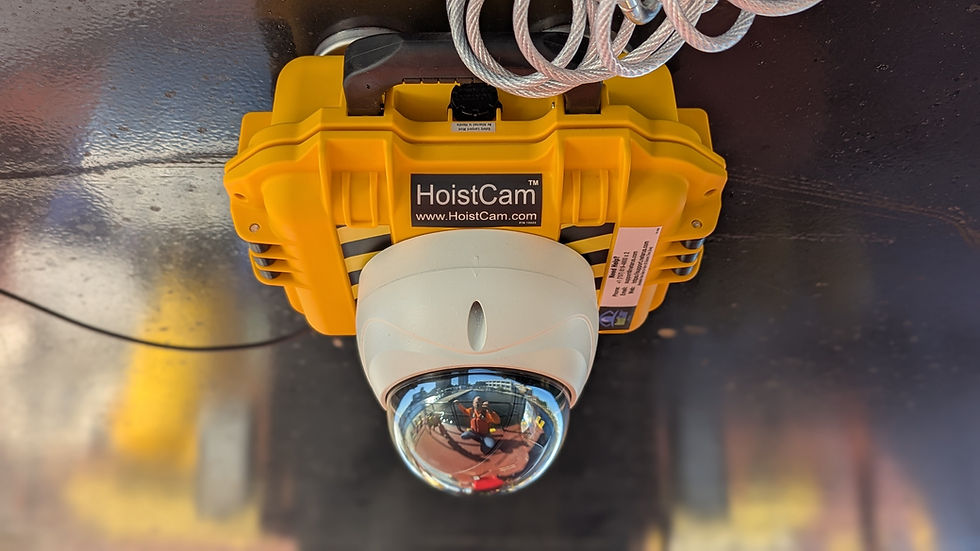
Using magnets, they mounted the camera to the hook block. The operator saw the load clearly. The ground crew adjusted faster. The lift stabilized and no one called it innovation. They called it useful and that distinction mattered.
Built With, Not Just For, Operators
What followed was not rapid scale. It was slow refinement.
HoistCam, officially launched in 2014 and introduced publicly at CONEXPO, was shaped by a steady stream of early adopters who were willing to test, critique, and challenge it. Construction crews, safety managers, supervisors, and operators all played a role.
Early prototypes were imperfect. Mounts were adjusted. Cables rerouted. Power systems rethought. Feedback came from muddy boots and radio chatter, not conference rooms.
The guiding principle emerged from those interactions: HoistCam would be an operator aid, not a safety device.
That distinction came directly from the field. Operators did not want a system that told them how to work. They wanted one that helped them see what they were already responsible for controlling.
That philosophy remains central today.
The People Who Made It Stick
By 2015, HoistCam moved into steel mills, ports, industrial plants, mining sites, and energy facilities, the same pattern repeated. Different environments. Same conversation.
Operators asked for clarity. Managers asked for reliability. Safety teams asked for tools that complemented, rather than complicated, existing processes.
HoistCam survived where many industrial technologies do not because it respected those roles. It did not try to replace people. It adapted to them.
That is how it found its way into some of the most demanding environments in North America, including major ports, power plants, nuclear facilities, and infrastructure sites like the Hoover Dam.
Reflecting on 2025 - A Product Shaped by Community
By the end of 2025, HoistCam had been deployed for more than ten years. It had been purchased, repurchased, shared between crews, and recommended from one jobsite to another.
That longevity is not accidental.
It reflects the contributions of:
Early customers who took a chance on unfinished prototypes
Operators who offered unfiltered feedback
Partners who helped deploy systems under real constraints
Teams who believed that visibility, even when imperfect, was better than working blind
HoistCam’s story is not just about technology. It is about trust built over time.
Why HoistCam Still Exists
In an era of rapid automation and bold promises, HoistCam has endured by staying grounded.
It exists because people asked for it.It evolved because people shaped it.It remains relevant because people continue to choose it.
As Machut has often said, “Knowledge of danger is often proof of liability.” HoistCam’s role has never been to document risk, but to give operators the information they need to work with confidence.
In 2026, HoistCam is not a new product. It is a proven one. And like most lasting industrial tools, it reflects the collective effort of the people who built it, tested it, challenged it, and relied on it.
Seeing the unseen was never a solo act.


